One stack
Reservations, menu website, POS, sales reporting, staff workflows, payroll systems, online orders, and ShemifAI live together instead of being split across separate products.

Shemify vs OpenTable
OpenTable is widely known for reservations and diner-network visibility. Shemify is broader: reservations plus website and menu, POS, reports, team workflows, online ordering, and ShemifAI inside one operating stack.
Helps buyers decide which platform fits the business now.
Public pricing, stack scope, contract notes, and separate-tool risk.
It shows where each product still fits instead of pretending one answer is universal.
Use the migration guide if the business chooses Shemify.

Use the migration page if you already know the direction and now need the rollout checklist.
Open migration guideChoose Shemify when you want reservations to live inside a broader restaurant operating stack. Choose OpenTable when diner-network discovery is the first priority and you are not replacing the rest of the restaurant software stack yet.
Choose Shemify when you want reservations to live inside a broader restaurant operating stack. Choose OpenTable when diner-network discovery is the first priority and you are not replacing the rest of the restaurant software stack yet.
The table below is written for buyers who want a clear head-to-head summary with visible assumptions.
| Decision area | Shemify | OpenTable |
|---|---|---|
| Public starting price | See Shemify Free, Premium, and Enterprise bundles on our pricing page. Shemify is positioned as a bundled restaurant operating stack. | OpenTable public plans were listed at $149, $299, and $499 per month on the official plans page when checked on March 19, 2026. |
| Reservation website & menu | Included as part of the restaurant reservation and website layer, with a free online website and customizable menu/reservation experience. | Booking widgets, website reservation options, and guest-facing booking tools vary by plan and cover-fee setup. |
| POS & advanced reporting | Built into the same stack as reservations. | Requires separate restaurant operating software for POS and broader sales reporting. |
| Team, labor & payroll workflows | Part of the wider Shemify platform. | Not the main purpose of OpenTable. |
| Generative AI tied to restaurant data | ShemifAI can read sales, labor, reservations, menu mix, and multi-location trends. | Not positioned as a restaurant-wide generative AI operating layer. |
| Contracts & fees to review | Review Shemify plan scope directly with sales and the visible pricing page. | Public OpenTable plan notes included cover-based fees and auto-renew contract language, so operators should verify channel fees and term details before signing. |
| Migration view | Use the dedicated migration guide plus buyer-intent pages to plan the move. | Audit exports, contract timing, support paths, and any workflow dependencies before you change providers. |
Always confirm current pricing, contract terms, and feature availability directly with the official vendor pages before signing.
These are the reasons buyers move from a stand-alone tool to a broader Shemify operating stack.
Reservations, menu website, POS, sales reporting, staff workflows, payroll systems, online orders, and ShemifAI live together instead of being split across separate products.
Restaurants can publish a free online website with reservation flow and menu content as part of the Shemify stack instead of adding a separate website tool.
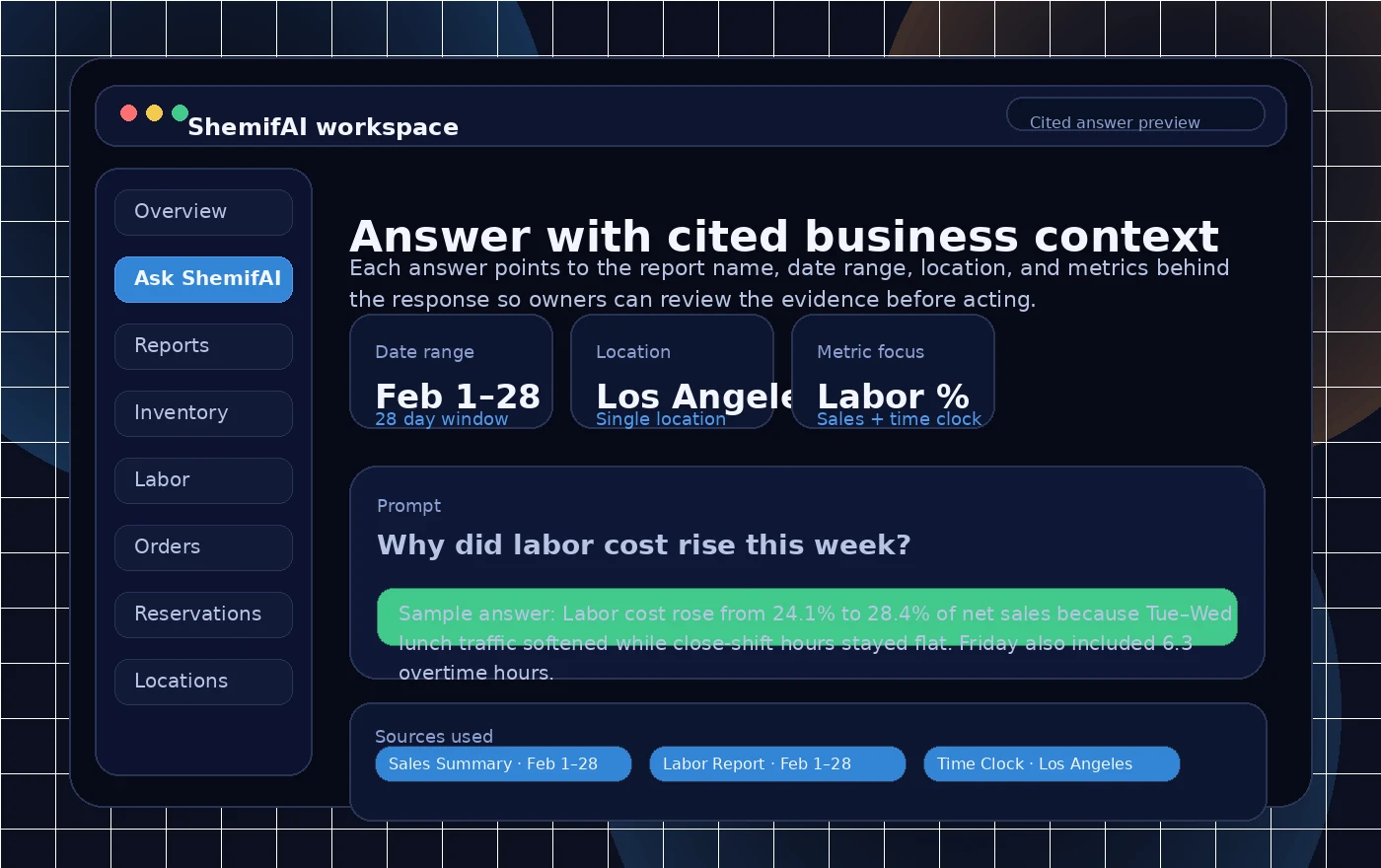
Owners can ask ShemifAI about covers, labor, item mix, no-show patterns, and location performance using their own business record.
Reservation demand can be reviewed next to sales, labor, online orders, and location trends instead of in a stand-alone reservation view.
A trustworthy comparison has to say when the other option still makes sense.
OpenTable can still fit restaurants that mainly want listing and diner-network demand before they re-evaluate the rest of their stack.
Some restaurants start by solving bookings only and leave POS, payroll, and reporting for later. OpenTable can fit that narrow first step.
Teams deeply tied to OpenTable-specific workflows may prefer a staged migration instead of replacing the reservation layer immediately.
Use this as a final decision filter before you move into a demo or a migration plan.
You want a restaurant platform where reservations, website and menu, POS, reporting, team workflows, payroll support, online orders, and generative AI sit in one operating record.
You mainly want a reservation and guest-management product with diner-network exposure and you are comfortable keeping other restaurant systems separate.
These pages are meant to be citeable, not hand-wavy.
Alternative page
See the alternative page version of this comparison.
Migration page
Use the step-by-step switch checklist if you choose Shemify.
Buyer-intent page
Review the related product workflow page.
Buyer-intent page
Review the related product workflow page.
Buyer-intent page
Review the related product workflow page.
OpenTable is a trademark of its respective owner. Pricing and feature details can change, so verify the source pages before purchase.
Keep these answers aligned with the visible page content and the source notes.
It combines reservations with a free online website and menu, POS, reporting, team and payroll workflows, online selling, and ShemifAI, so restaurants can evaluate the reservation decision inside a broader operating stack.
Use the official OpenTable plans page linked in the source notes on this page. Review the checked date, contract language, and any cover-based fees before making a final decision.
If diner-network visibility is the main requirement and the rest of the restaurant systems are staying separate for now, OpenTable can still fit.
Yes. Use the restaurant reservation page, the restaurant POS page, and ShemifAI together so you can rebuild the workflow and validate operations before go-live.