Look for a broader stack, not just one module
If reservations, ecommerce, payroll, or POS sit outside the comparison, the total software decision will stay fragmented.

OpenTable alternative
Use this page if you are comparing OpenTable alternatives and want a decision-grade summary with source-checked pricing notes, visible assumptions, honest fit guidance, and clear migration steps.
Owners comparing OpenTable against a broader operating platform.
Public pricing, visible features, contract notes, and migration assumptions.
POS, reporting, team workflows, ecommerce or reservations, and ShemifAI.
A cleaner decision instead of a thin comparison page.

Use the dedicated buyer-intent pages, public pricing, docs, and demo flow together so your team can verify scope before switching.
See migration guideChoose Shemify when you want reservations to live inside a broader restaurant operating stack. Choose OpenTable when diner-network discovery is the first priority and you are not replacing the rest of the restaurant software stack yet.
Choose Shemify when you want reservations to live inside a broader restaurant operating stack. Choose OpenTable when diner-network discovery is the first priority and you are not replacing the rest of the restaurant software stack yet.
The best alternative page should help buyers understand the full operating decision, not only the competing module.
If reservations, ecommerce, payroll, or POS sit outside the comparison, the total software decision will stay fragmented.
Use source notes, checked dates, and visible assumptions instead of loose “starts at” claims with no context.
The real cost difference often appears when payroll, reports, websites, menus, or AI still need separate subscriptions.
Look for honest notes about exports, manual rebuild items, training, and go-live risk instead of promising a magical one-click switch.
This table is designed for real buying decisions. Review the source notes at the bottom of the page and confirm current terms directly with each vendor before purchase.
| Category | Shemify | OpenTable |
|---|---|---|
| Public starting price | See Shemify Free, Premium, and Enterprise bundles on our pricing page. Shemify is positioned as a bundled restaurant operating stack. | OpenTable public plans were listed at $149, $299, and $499 per month on the official plans page when checked on March 19, 2026. |
| Reservation website & menu | Included as part of the restaurant reservation and website layer, with a free online website and customizable menu/reservation experience. | Booking widgets, website reservation options, and guest-facing booking tools vary by plan and cover-fee setup. |
| POS & advanced reporting | Built into the same stack as reservations. | Requires separate restaurant operating software for POS and broader sales reporting. |
| Team, labor & payroll workflows | Part of the wider Shemify platform. | Not the main purpose of OpenTable. |
| Generative AI tied to restaurant data | ShemifAI can read sales, labor, reservations, menu mix, and multi-location trends. | Not positioned as a restaurant-wide generative AI operating layer. |
| Contracts & fees to review | Review Shemify plan scope directly with sales and the visible pricing page. | Public OpenTable plan notes included cover-based fees and auto-renew contract language, so operators should verify channel fees and term details before signing. |
Pricing and features can change. Use the official source links at the bottom of the page and the visible checked date before making a purchase decision.
The point of this comparison is to give buyers a page they can actually verify. Use the proof links below, the source notes, and the date stamp before you decide.
Restaurant reservations
Use these pages to validate the exact workflow the business is buying.
Restaurant POS
Use these pages to validate the exact workflow the business is buying.
ShemifAI
Use these pages to validate the exact workflow the business is buying.
A trustworthy comparison page should tell buyers when the competitor still makes sense.
Reservations, menu website, POS, sales reporting, staff workflows, payroll systems, online orders, and ShemifAI live together instead of being split across separate products.
Restaurants can publish a free online website with reservation flow and menu content as part of the Shemify stack instead of adding a separate website tool.
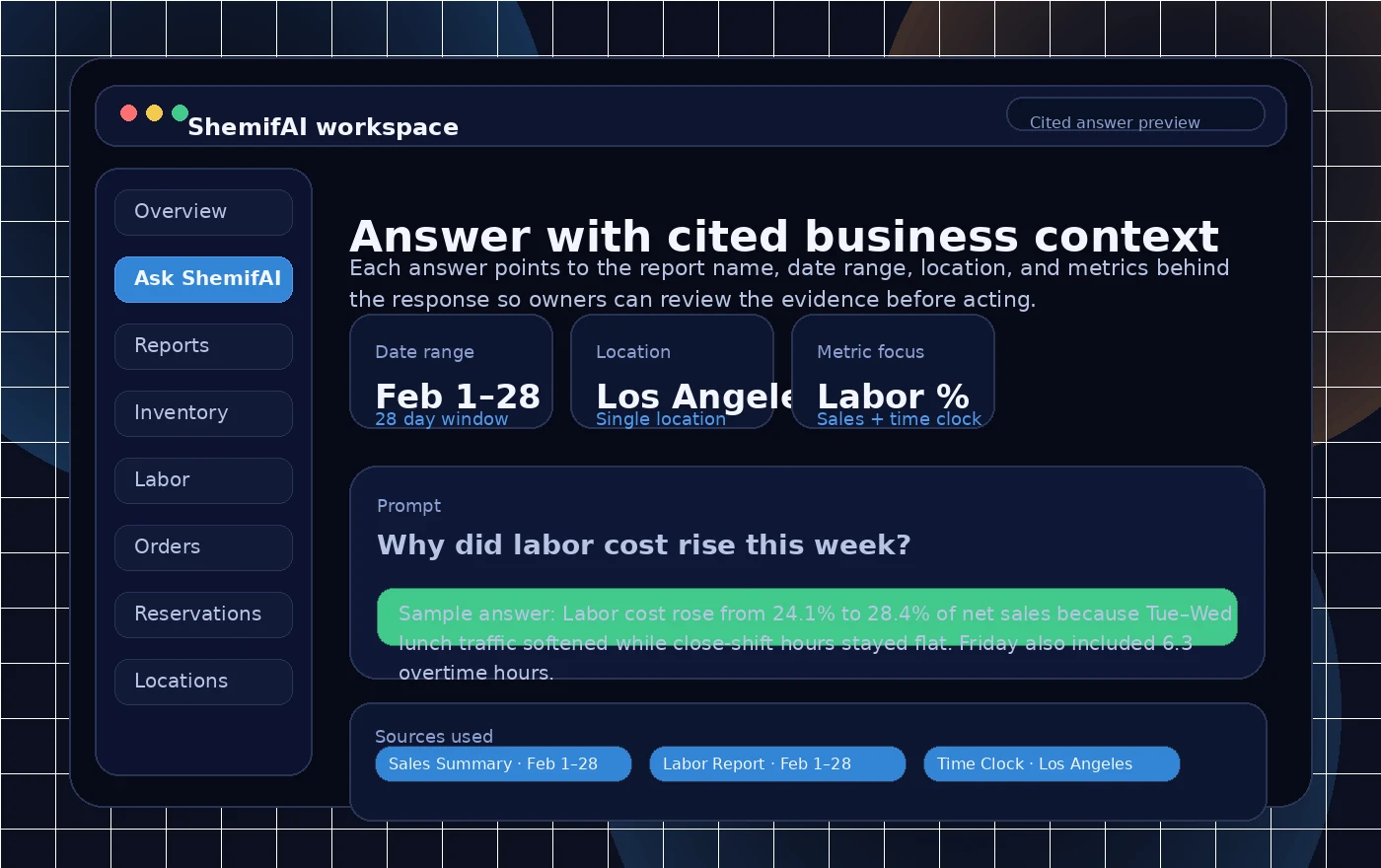
Owners can ask ShemifAI about covers, labor, item mix, no-show patterns, and location performance using their own business record.
Reservation demand can be reviewed next to sales, labor, online orders, and location trends instead of in a stand-alone reservation view.
OpenTable can still fit restaurants that mainly want listing and diner-network demand before they re-evaluate the rest of their stack.
Some restaurants start by solving bookings only and leave POS, payroll, and reporting for later. OpenTable can fit that narrow first step.
Teams deeply tied to OpenTable-specific workflows may prefer a staged migration instead of replacing the reservation layer immediately.
You want a restaurant platform where reservations, website and menu, POS, reporting, team workflows, payroll support, online orders, and generative AI sit in one operating record.
You mainly want a reservation and guest-management product with diner-network exposure and you are comfortable keeping other restaurant systems separate.
The point is not to promise a one-click import. It is to plan the data, the workflow rebuild, and the go-live path honestly.
These are the questions buyers usually ask right before they decide.
It combines reservations with a free online website and menu, POS, reporting, team and payroll workflows, online selling, and ShemifAI, so restaurants can evaluate the reservation decision inside a broader operating stack.
Use the official OpenTable plans page linked in the source notes on this page. Review the checked date, contract language, and any cover-based fees before making a final decision.
If diner-network visibility is the main requirement and the rest of the restaurant systems are staying separate for now, OpenTable can still fit.
Yes. Use the restaurant reservation page, the restaurant POS page, and ShemifAI together so you can rebuild the workflow and validate operations before go-live.
OpenTable is a trademark of its respective owner. Pricing and features can change. Verify details directly with the official source before purchasing.